Really Want Transparent Government in SC?

The press in South Carolina has pointed to two transparency issues in recent days.  Governor Haley and her staff routinely delete emails and texts we are told.  Meanwhile the Department of Education told Sumter Senator Phil Leventis that it would cost half a million to respond to a Freedom of Information Act (FOIA) request for documents.  South Carolina has taken a number of steps to make our government(s) more transparent.  Some of them are even helpful. But we have a long way to go to useful transparency.

I have doubts about some of those measures like the mandatory roll calls on far too many bills on the floor of the House and the Senate. A small number of members could … and did request roll calls on bills. But it is useful to have the roll call votes available on the website without having to wade through the journals of each body. If they wanted us actually to use those reports, however, they would put them in a downloadable format that you could read into a database program to analyze without having to write a software routine to parse the page.

If you really want transparency on roll calls, however, you would not publish just floor votes but, more importantly, subcommittee and committee votes.  As a lobbyist I knew that the ballgame was over by the time a bill reached the floor.  Substantive amendments rarely happen on the floor. If I wanted to really change a bill, the best place is in a subcommittee.  There, you can put in the qualifiers, add teeth, remove teeth, repeatedly adjourn debate or flip the bill so that it does the opposite of what the proponents wanted.  Reporters usually only cover subcommittees if they have been told there will be a dog fight.  Even if a vote is recorded, it is not readily available to the public.  Subcommittee and committee votes should be published on the legislative website along with the language the vote addresses.

Many of our transparency resources are better designed to find gotchas than to do analysis.  Running down patterns in Ethics Commission filings is a pain in the derriere even with the information online.  Why not just provide ways for a data dump so that the press, researchers and citizens can go data mining.  Likewise, I can drill down in this year’s year-to-date spending for state agencies on the Comptroller’s site to find out who got paid what.  But I can’t do that by agency for prior years. I have to drill down by vendor, guessing at whom got paid by who.  It’s all in the computer.  Let me —and everyone else—dump it to my computer and analyze to my heart’s content.

The opaque transparency provided by the websites is nothing compared to the abuses of FOIA and the Open Meetings Act.  I’ll leave aside the wholesale disregard for the Open Meetings Act among local governments.  I frequently ask state agencies for information and data.  If it’s something they want me to have or don’t care about, I get it in a reply email.  If they don’t want me to have it, I’ll be told that they “will handle that as a FOIA request.” I recently asked one state agency: “Does that mean you’ll drag your feet and charge me a bunch of money for it?”  Instead of being a tool for transparency, the agencies use the Act as a barrier to transparency, reading its deadlines as “no sooner than” and employing its cost-shifting provisions to stop inquiries.

Senator Jake Knotts, during Thursday’s Fiscal Fitness Subcommittee meeting, opined that the General Assembly should set the cost of copying because of the ways agencies used it to shield information.  The General Assembly should address the cost issue, but also the use of deadlines to delay.  I’m usually after data and not dirt.  The more the agencies put and keep their data on the web in a format I can use for analysis, the less I and other citizens have to ask for.  If agencies don’t want actions which embarrass them uncovered by searches for dirt, they should only do things of which they would not be embarrassed. It is the People’s Business.

I’ll write about economic development transparency later.

Posted in Transparency | Leave a comment

SC Senate Fiscal Fitness Subcommittee Reports Bills Out

The South Carolina Senate Judiciary’s Subcommittee on Fiscal Fitness (Sens. McConnell, Knotts, Malloy, Sheheen, Davis and Shoopman) met in Columbia today (December 7) to, more or less, finalize its recommendations on changes to the Full Judiciary Committee.

Streamlining Commission. The subcommittee discussed, but did not have language on, replicating the Louisiana Commission on Streamlining Government. They reported out S. 10 understanding that it would be amended. There is no doubt that South Carolina could do a lot to improve how state government functions. However, the mission of such a Commission should be just that, better government, and not just looking for ways to cut spending. At some point, South Carolina’s leaders need to figure out the notion of value, bang for the buck, and not just focus on how much we spend. The Louisiana Commission is heavy on “private enterprise” folks, plus some politicians and a representative of the Louisiana AFL-CIO. Sen. McConnell made clear that the “private group” was not going to have a voice, but he wanted both business and consumers.

Sen. McConnell indicated that he was interested in Zero-Based budgeting. A closer look might suggest that no state really adopts pure zero-based budgeting and it has its pluses and minuses. As the legislation moves forward, we’ll be writing more on this.

Budget Stabilization Fund. SC needs a large rainy day fund to get us through hard times by building up reserves in good times. Our General Reserve Fund is too small (5 % of the General Fund) and can only be accessed when there is an actual deficit. The subcommittee reported out Senator McConnell’s S. 3, a proposed Constitutional amendment. The implementing language is in Senate Finance (S. 4 ). This is a wise approach which I commended in testimony to the subcommittee and about which I have previously written.

Recognizing Deficits. For several years, the Department of Corrections ran budget deficits. Last year, Health & Human Services announced a $228 million projected deficit, largely the product of providing an inadequate request to the General Assembly in the first place. Currently, the Budget & Control Board can “recognize” a deficit, allowing a state agency to overspend its budget. Those funds have to be paid out of surplus or covered from the following year’s budget. The Medicaid deficit set the General Assembly into an uproar.

The subcommittee amended S. 372 to replace the existing provisions and assign responsibility for recognizing deficits to the General Assembly by majority vote in each House. The General Assembly will have to find that the impending deficit is both beyond the agency’s control and unavoidable . The amendment also will require agencies to report quarterly on their spending and, if exceeding the expected spending, to notify the General Assembly within 14 days. Health & Human Services waited until after the 2010 General Election.

“Regulatory Reform”. In 2011, 18 regulations went into effect because they were not approved or disapproved by the General Assembly within the 120 day review period. H. 3226, amended, would require every regulation to have an affirmative vote to go into effect. Further, it would prohibit fee increases in the Appropriations bill, requiring that they be in separate legislation. The explanations did not make clear whether you could raise a fee in a regulation, as long as it was voted on.

Sen. Vince Sheheen, who voted against the bill, urged that a single Senator (or 2 or 3) not be able to stop consideration of a regulation, effectively killing it. He indicated that he might support the bill if that was fixed by, perhaps, requiring consideration automatically within a certain number of days.  Agencies already face the terrors of the damned in getting regulations approved. It shouldn’t be made impossible to get any decent regulation through the General Assembly.

“Taxpayer Fairness Act”. Intended to stop the Department of Revenue from expanding the tax code through interpretations, the bill (S. 11) will create a rebuttable presumption that a taxpayer does not have to pay if a tax statute is unclear. We thought that a Law of Nature required that tax statutes be unclear, but we sure can’t wait to see the statutory definition of an “unclear statute”.

Trust Funds. In hard times, the General Assembly has been known to raid trust funds. S. 12, a proposed Constitutional amendment, would prohibit that unless the General Assembly passed a separate law to change the purpose of the trust fund.

When the General Assembly returns, the Judiciary Committee will have a full plate.

Posted in SC Budget | Tagged , , , , | Leave a comment

Real Fiscal Fitness for South Carolina: It’s Not Spending Caps

South Carolina needs to make changes to improve its fiscal fitness.  Adopting the Budget Stabilization Fund advanced by Senator McConnell in the past few years would be an important start, holding excess revenues in good times and protecting against damaging cuts in bad.  So, too would taking a  longer view than our one-year budgeting horizon. Pay-as-you-go budgeting, supported by multi-year revenue and cost projections and current services budgeting, is far preferable to rigid, formula-based limits that do little to address the actual long term needs of our state and undermine the ability of the General Assembly to determine and fund our state’s needs.

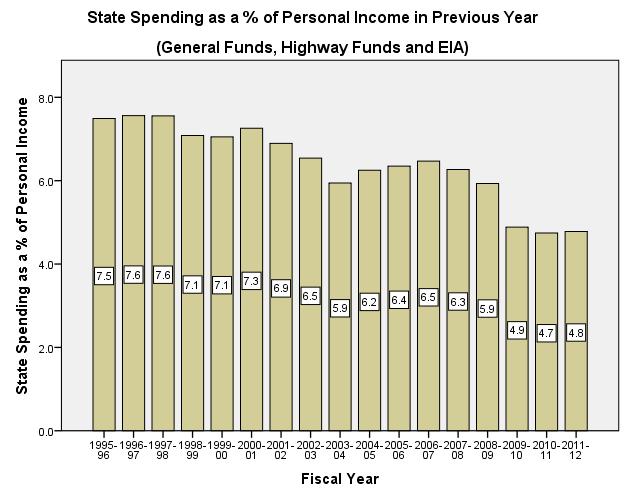
Many have claimed a need to limit the ability of the General Assembly to appropriate funds in coming years by imposing a spending limit of some sort.  South Carolina, of course, currently has a spending cap based on “the average growth rate of the economy of the State,” measured by the growth in personal income. In other words, we already cap spending based on the growth in the ability of our citizens to pay those taxes.  State spending (General Fund, highway funds and EIA) has been shrinking relative to personal income – the best measure of our ability to pay for public goods.  In FY95-96, we spent 7.5 percent of personal income.  In FY11-12, we are spending 4.8 percent.

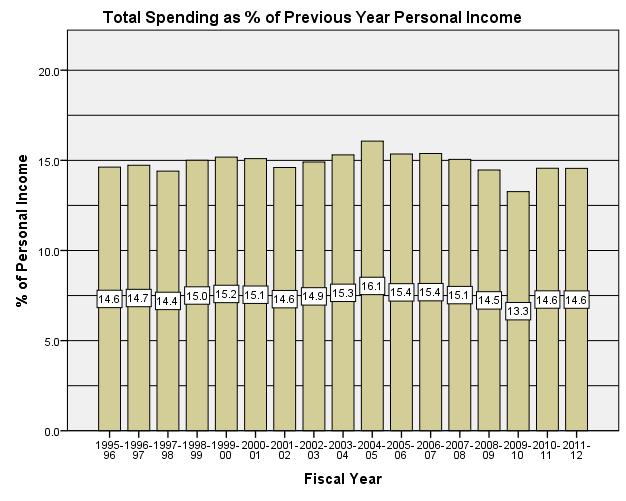
Many have argued that looking at only General Fund spending is wrong-headed because the General Fund is now a smaller part of total spending.  However, Total Funds (General Funds, Other Funds and Federal Funds) have not dramatically increased as
a percentage of previous years Personal Income in South Carolina.  Although there was a slight bulge in the middle of the past decade, FY2011-12 appropriations are the same proportion of state personal income as it was in FY1995-96—14.6 %.

Leaving  aside the constitutional and statutory spending limitation currently in effect, South Carolina has a stricter spending limit that has effectively limited state spending: the General Assembly can’t spend more than it has.

A stricter spending limit may be attractive to some.  You should exercise extreme caution.  Colorado in 1992 adopted as strict revenue limit known as TABOR, the Tax Payers Bill of Rights.  That revenue limit so hobbled the state that Coloradovoters suspended key parts of it for five years in November of 2005.  Colorado business and political leaders of both parties have concluded that a strict cap like TABOR is bad for the state’s economy.  Neil Westergaard, Editor of the Denver Business Journal, has declared that “[Business leaders] have figured out that no business would survive if it were run like the TABOR faithful say Colorado should be run — with withering tax support for college and universities, underfunded public schools and a future of crumbling roads and bridges.” —We urge the members to review the video, The Real Story behind TABOR, at http://www.cbpp.org/cms/index.cfm?fa=view&id=2482 on the experience ofColorado with a strict revenue limit known as TABOR.

If we were to revise our spending cap, the General Assembly needs to be very careful of its design. Some have suggested indexing spending by the growth in population plus the growth in the Consumer Price Index (CPI). CPI is a measure of change in consumer spending based upon pricing a market basket of goods and services purchased by households.  However, government buys a very different set of goods and services than do households.  (See Table 1 on next page.)  For example, households don’t run prisons.

Unfortunately, the cost of things that government buys – K-12 education, health care, higher education and transportation – grows faster than the cost of things which households buy for a number of reasons entirely unrelated to management effectiveness.

The net effect is that a spending cap indexed to the CPI effectively shrinks government in terms of the services delivered to citizens.  See David H. Bradley, Nicholas Johnson, and Iris J. Lav, The Flawed “Population Plus Inflation” Formula: Why Tabor’s Growth Formula Doesn’t Work, Center on Budget & Policy Priorities (January 13, 2005) at http://www.cbpp.org/cms/?fa=view&id=861.

If you do include an inflation factor, the appropriate inflation factor for the things which government does buy is the deflator for state and local governments. That figure is readily available through the U.S. Department of Commerce, Bureau of Economic Analysis, as a part of the National Income and Product Accounts (NIPA) series used to estimate U.S. Gross Domestic Product.

A significant structural flaw to most spending limit proposals is the Ratchet Effect.  If you tie the spending limit to the previous year’s appropriation, you ratchet down spending when the budget is cut.  When revenues recover coming out of a downturn, the new, lower spending limit makes those recovering revenues unavailable to put troopers on the highways, corrections officers back in the prisons and teachers in the classrooms.

If you fall in a well, you cannot get out by just moving forward.  You have to climb first. Any spending limit should be designed so that it does not re-base the limit when spending declines.

You should only craft a flexible spending limit so that major events or needs can be addressed.  For example, it is unclear to us that the General Assembly could have enacted Act 388 – which added over half a billion in revenues and costs to the state budget – if an inflexible spending limit had been in place.  The General Assembly could not have adopted the EIA.  In the future,South Carolinawill need to address a crumbling infrastructure.  We may need to deal with natural disasters, court rulings or federal mandates.  Without flexibility, the General Assembly’s only recourse will be to gut high priority services that you will want to fund and which common sense will say you should fund.

South Carolina does need to make changes to how it does business in order to improve our fiscal fitness.  A major problem with keeping our fiscal house in order is that we have a one-year planning horizon and make short-term decisions.  As a result, members of the neither General Assembly nor the public are able to understand the long-term impact of tax and budget decisions.  In recent years, the General Assembly cut taxes in good times and then had to cut services in bad times because it had only a one-year budget horizon. Likewise, if you begin new programs in good times, you have to cut either those programs or others when the inevitable downturn comes.

If the General Assembly adopted a few budget management tools,[1] South Carolina could better maintain budget discipline without forgoing flexibility.  The cornerstone is a policy requiring that the General Assembly fully offset the cost of spending increases or revenue decreases over a five-year period through spending cuts or revenue increases.  This is known as pay-as-you-go (PAYGO) budgeting.

To do pay-as-you-go budgeting well, two additional tools are important.  The first is multi-year budgeting … projecting both revenues and expenditures over several years as a central part of the budgeting process.  Needless to say, those have to be realistic economic estimates. The other is “current services budgeting,” basing budgets on continuing current levels of services, given expected changes in the expected number of recipients, per-recipient cost and other factors.

As state budget expert, Iris Lav (see fn. 1) notes:

Today in most states, it is impossible for policymakers to know whether proposed program increases or tax cuts are affordable over the longer term.  Nor do most states have appropriate mechanisms for considering and implementing tradeoffs among fiscal policy options.  These problems impede decision-making and leave states vulnerable to serious long-term budget problems.  These budgeting tools help states avoid enacting either spending hikes or tax cuts in flush times that are not affordable long-term.

Unlike a rigid spending limit, a pay-as-you-go budget process maintains legislative prerogatives over the budget and allows for the possibility of program expansions or tax reductions when they are affordable.

Over the years, Senators have indicated that the underlying structural budget concern was the effect of business cycles on the state budget leading to boom and bust budgeting.

The solution to that is saving during good times to have funds available in bad times.  Unfortunately,South Carolina’s Rainy Day Fund – the General Reserve Fund – is more like a Flood Fund.  We can only use the General Reserve Fund when we are already underwater to cover operating deficits.  At its Constitutional limit of, eventually, 5 percent of the General Fund, it is far too small to meaningfully carrySouth Carolinathrough as much as one year.  Our experience over the past few years indicates that a 20 percent reserve is more appropriate.

The other flaw withSouth Carolina’s General Reserve Fund is that it has to be paid back too soon—beginning in the year after it is tapped.  Down cycles tend to last two to three years.  That means that you are forced to refill the Rainy Day Fund while you may still underwater. It’s like putting money in savings when rain is still falling, your basement’s flooded and you really need to repair the leaky roof.

We would urge that you change the Constitution to require a larger and more flexible Rainy Day Fund designed as a savings account to get the state through economic downturns with less budgetary disruption and regularized funding of services for our citizens.  Additionally, we would urge you to change the repayment requirements so that the state has moved out of the down cycle before the General Assembly is forced to repay the Rainy Day Fund.

Senator McConnell has over the past few years introduced a Budget Stabilization Fund, which, with a  couple of tweaks, is an excellent approach to a Rainy Day Fund.

Combining pay-as-you-go budgeting, supported by multi-year revenue and cost projections and current services budgeting, with a large Rainy Day Fund to hold excess revenues in good times and protect against damaging cuts in bad would go a long way to improving the fiscal fitness of our state. These approaches are far preferable to rigid, formula-based limits that do little to address the actual long term needs of our state and undermine the ability of the General Assembly to determine and fund our state’s needs.

Presented to SC Senate Judiciary Subcommittee on Fiscal Fitness, November 16, 2011, on behalf of SC Appleseed Legal Justice Center and AARP-SC.

[1] This discussion follows Iris J. Lav, PAYGO: Improving State Budget Discipline While Retaining Flexibility (Center on Budget and Policy Priorities, September 22, 2011) at http://www.cbpp.org/files/9-22-11sfp.pdf.
Posted in SC Budget | Tagged , | 1 Comment

The Rest of the Story on South Carolina Sales Tax Exemptions

The debate over South Carolina sales tax exemptions and caps is heating up. Some clarity is needed.

In Sunday’s The State, SC Senate President Pro Tempore Glenn McConnell and House Speaker Bobby Harrell (http://www.thestate.com/2011/11/06/2034930/harrell-mcconnell-beware-democrats.html) attack the litigation filed by Democratic Party Chair Dick Harpootlian questioning the constitutionality of the hodge-podge of exemptions (and caps) to our state’s income tax. McConnell and Harrell claim: “A $3 billion tax increase could be forced on all South Carolinians if a lawsuit before the state Supreme Court succeeds.” Of course, were the Supreme Court to find all of those exemptions and caps unconstitutional, the General Assembly could quickly reset the sales tax rate to nullify part or all of the revenue-adding effects of that decision.

Meanwhile, Dr. Mike Fanning runs around the state on behalf of ROAR (http://www.roarsc.com/) , with his humorous attack on the silliest of the exemptions and caps, “…dedicated to the single issue of reducing our tax rates through honest tax reform that’s dedicated to putting an end to special interest exemptions.” Fanning, and others note, that “… by allowing 80+ sales tax exemptions, we exempt more ($2.7 billion) annually than actually collected ($2.5 billion).”

Except for car dealers, we know of no thoughtful person who finds virtue in the fact that a purchaser of a $6,000 used car pays the same sales tax as the purchaser of a $2.4 million Buggati Vayron … $300. Nor do the multiple loopholes in our August back-to-school sales tax holiday which allow for the tax-free purchase of wedding gowns and lawyers’ office supplies make much sense.

What you quickly discover as you look closely at the exemptions (http://www.bcb.sc.gov/BCB/bea/exemptions.pdf) is that the real money is not in “special interest exemptions” or poorly drafted sales tax holidays. Instead, the big dollar sales tax exemptions are those which hit most heavily on everyday consumers and especially low-income consumers.

Long before we get to the truly obnoxious cap on sales taxes on cars, planes and boats and the multitude of other chump-change exemptions, the real money is in prescription drugs purchased at pharmacies ($585 million), groceries ($354 million) and electricity or other fuel used for home heating ($188 million). That is not to mention the $253 million from sales to the Federal government that is not taxable under the US Constitution or the $500 million in highway fuel which is simply taxed another way. Altogether, that’s $1.88 billion of the $2.7 billion that is “sitting out there” in sales tax exemptions.

Everyone understands that sales taxes are our most regressive tax … they land much more substantially on the poor than the wealthy. The Institute on Taxation and Economic Policy’s examination of tax burdens in South Carolina (http://www.itepnet.org/wp2009/sc_whopays_factsheet.pdf) found that in 2007 those with the lowest 20 % of incomes paid 5.1 % of their income in sales taxes while the wealthiest 1 % paid .8 %. Adding sales taxes on prescription drugs, groceries and home heating fuels and electricity together represents $1.127 billion of the new taxes that will have an especially hard impact on low-income consumers. The elimination of the sales tax on groceries was an explicit attempt by the Republican-controlled General Assembly to reduce some of the regressive impact of the property tax for sales tax swap embodied in Act 388 of 2006. That law raised sales taxes on low income renters while giving them not a penny of property tax relief.

There are ways to reduce the regressive effects of charging sales taxes on additional items and services. Those include a State EITC which provides a refundable, tax credit to working poor families or a refundable low-income tax credit that is not limited to working people and helps the low-income unemployed, disabled and elderly as well.

No doubt, South Carolina needs to find new revenues and to better balance its tax base. There are many ways to do that which are substantially less regressive than eliminating sales tax exemptions on necessities like prescription drugs, groceries and home heating fuels. We will be talking about some of those in coming posts. Meanwhile we continue to wonder why Democrats appear so focused on the most regressive approach to new revenues … eliminating sales tax exemptions.

Posted in Taxes | Tagged | 1 Comment